Wednesday, April 29, 2009

DIY: my cheap little sheep

Speaking of DIY, my latest passion is feeding my knitting habit with thrift store yarn. Most stores combine several skeins into a bag according to someone's idea of a "color story" and charge around 2 or 3 dollars for the whole set. Given that there are usually 5-7 skeins of yarn in a bag, this a is  GREAT deal. The first bag is going towards a granny square afghan that won't be done until next winter. About a month ago I scored a wonderful assortedment of neutral-colored wool and wool/acrylic blends, including an undyed alpaca (now a double-cable scarf) and some curly wool blend that is turning into a herd of these:


The pattern is from Toy Knits by Debbie Bliss.

Upcycling and big retail: good news (?)

The New York Time has an interesting article today about upcycling (using waste materials to create new products) , built around an interview with Terracycle Inc.'s founder Tom Szaky. Upcycling has been around long before the word was coined in by the authors of Cradle to Cradle: Remaking the Way We Make Things (2002) -- remember all the jeans-to-skirt transformations of the late 1960S -- but it's usually been a small-scale activity, at the production and/or retail level. It's not too hard to find individual DIY-ers who upcycle, or to find boutiques and specialty stores who sell products made from "trash".

These efforts make large individual statements, but a more modest environmental impact. What is striking -- and hopeful -- about the Terracycle story is the scale of the operation. They buy their raw materials -- soda bottle and juice boxes -- from churchs and schools who collect them, and they sell them in huge quanities through Wal-Mart and Target. The low cost makes Terracycle's goods accessible to people who can't afford to pay the "green premium" that more affluent consumers are willing to pay.

I can imagine that in my college classroom, this would spin into a discussion on big box vs. small retailers, the impact of corporate upcycling on fair trade craft industries in developing counties and other compicated ethical and economic issues. This still feels like mostly good news to me; what say the readers?

(Thanks to the best son-in-law on the planet for this tip!)

Monday, April 27, 2009

Bamboo rayon, continued

Mo Saintsing of Bamboosa replied to my Earth Day post about bamboo rayon, pointing out -- quite correctly -- that Bamboosa has taken the high road on producing and marketing bamboo apparel. I've given them a hat-tip in the past and wish more companies would follow their lead. I do still wish they would use the FTC terminology for their fibers, just for the sake of clarity and because it's the right (and legal!) thing to do. The FTC is apparently not about to enforce of the Textile Fiber Products Labeling Act, because, as their representative said last summer, "it's not a rollover issue", i.e., no one is dying.

Here's the issue for me: there are scores of companies out there who do NOT use certified organic bamboo (if they did, wouldn't they say so?) and who AREN'T working with fiber producers to minimize the environmental impact of growing and processing bamboo into viscose rayon. They are not only competing with ethical producers, they are sowing the seeds of consumer backlash when the bamboo boom goes bust. Yesterday I saw a shampoo that featured green tea and bamboo among the ingredients, with all the usual claims for both (antioxident! antibacterial!).

Bamboosa's clothing may look, feel and wear better than most rayon, but if someone buys someone else's shirt first and it behaves like inexpensive rayon instead of the miracle fabric they thought they just paid a premium for, they will associate that outcome with bamboo. I have purchased and tested bamboo and bamboo-blend socks, towels, yarn and a T-shirt, and my samples behaved like rayon. The socks and T-shirt pilled, the towels shrank alarmingly and the yarn and T-shirt lost some elasticity and their silk-like hand.

For the time-being, the environmentally-conscious fashion consumer is on her own. There are standards and certifications, but right now the market is flooded with new "green" materials that ignore those standards, beginning with the FTC textile regulations. I prefer to do business with companies who treat me with respect and give me facts. Finding "rayon from bamboo" on the label is a step towards winning my trust.


Course description: Advanced Material Culture: Craft and Production

So I have a more formal description for my fall course! AMST498Q Advanced Material Culture: Craft and Production. This course will build on the theoretical foundation of AMST 205, using multiple approaches (ethnography, object analysis, history) to examine the
production of objects and the relationship between maker and artifact. Topics will include historical reenactment, professional craftspeople and amateur DIY (including gardening, knitting, furniture hacking, and all forms of cookery). Students will be expected to be willing to work and interact outside the classroom (required field trips and online activities).

I also have two books on order: Jane Dusselier's Artifacts of Loss (crafts in Japanese-American internment camps) and Shaping Things, Bruce Sterlings' very interesting (and very rich) work on the future of things. Dusselier's book will be a great way to reposition the discussion about crafts, which can get stuck on the mindless-hobby level. I actually don't believe that most amateur crafting is just so much meaningless filler;  when any activity consumes someone's time, money and energy, it has meaning and is worth serious consideration by cultural scholars. Being dismissive of scrapbookers is elitist and probably sexist.

There are seven students registered for the class so far and we don't start until August; exciting!

Wednesday, April 22, 2009

Circular blogging: craft=power

It's the truth: my daughter writes better than I do. Here's her take on the importance of craft. How did "crafts" ever, EVER become a dirty word? Happy Earth Day, y'all!

Is bamboo really green? What's an earth-loving fashionista to do?

I've been collecting news articles for the last week, mulling over the possibilities for an Earth Day post. There were some great articles about trashion shows and Earth Day promotions by a wide range of companies. Anyone in search of fun and creative DIY projects for kids or adults will have a merry time this week, as well. I'll feature those in Friday's Hits and Misses post. But I was finally convinced that it's time to go back to an old stand-by: greenwashing and bamboo.

"Is bamboo fabric/yarn really green?". I get this question all the time, and my answer hasn't changed: it's as green as viscose rayon made from any other material. Rayon (called viscose outside the U.S.) is a regenerated cellulose fiber, made from unspinnable waste cotton, wood pulp or other plant material -- such as bamboo. It is as "natural" as Spam, because in order to create a usable fiber, the plant material is chemically dissolved using a process so dirty that it is no longer made in the U.S. and the remaining sites where it was made are some of the nastiest "superfund" sites on the EPA's clean-up list. (There is a much cleaner cousin to viscose, called lyocel -- often marketed as tencel -- in which the chemicals are captured and reused. It's a better choice.)

If you read ads and labels for bamboo clothing, you would think otherwise. My daily news alerts bring in dozens of articles and announcements touting bamboo yarn, diapers, skirts and other products as green, environmentally friendly and sustainable. Hardly any use the r_ _ _ _ word, despite the fact that textile labeling regulations in the U.S. require that they use "rayon" if a product is made of regenerated cellulose using the viscose process. The FTC does not recognize "bamboo" as an approved textile label. Period.(By the way, enforcing existing regulations would be a nice change, President Obama!)

I have written about this before.

So please don't buy bamboo rayon in order to be green. Buy it if you like the hand (it's cool, soft and drapey, like all other rayon). Avoid it if you don't like rayon's less-wonderful characteristics (it abrades easily and pills like crazy). I do have some bamboo rayon items in my own wardrobe, just as I have a few rayon pieces of unknown origin. (I am pragmatist, not a purist.) But millions of American consumers flocking to bamboo viscose will not save the planet.

What can you do? The answer is not so much what you buy, but how you launder it, how long you wear it, and where it goes when you're done with it. Buy clothing designed to last years, not a season. (For kids, that means more hand-me-downs and second-hand clothing.) Wash it in cold water and line-dry it, when possible. When it no longer serves your needs, send it on to someone else or make it into something new.

Friday, April 17, 2009

Hits and Misses 4/11-17

The internets are full of news and information about green fashion and conscious consumption, I've decided to aggregate the best and the worst into a single post about once a week.

Hits:


Misses:

My current project: a double cable scarf made out of some 100% alpaca yarn I picked up along with 4 other assorted skeins for $1.99 at my local thrift shop. Also, with the local weather steadily warming up, I have my small garden half planted (spinach, peas, lettuce) and am preparing the rest for tomatoes and cubanel peppers. The closest farmers' market opens next weekend. Ain't life grand!


Wednesday, April 15, 2009

Green Fashion Roundup -- Earth Day, Loomstate for Target, green BOGO at Payless

With Earth Day coming up, the volume of green fashion news is expanding. Here are a few tasty morsels from my inbox:

Business events for Earth Day/April 2009 (KABC-TV in Los Angeles) spotlights environmentally-themed events and promotions from Macy's, Disney Stores, JCPenny and others. My personal favorite: "Hoochie on the Coochie", the "blue jeans chic" dinner dance benefit for the Georgia Nature Conservancy.

Loomstate + Target = affordable green fashion (complex.com) Loomstate's organic cotton t-shirts and jeans are wonderful -- and pricey! On April 19, you will be able to find a new Loomstate organic collection at your local Target. Very good news.

Green BOGO at Payless (PR Newswire - sev.prnewswire.com) will promote the discount shoe chain's new Zoe & Zac green brand. Payless will donate a minimum $100,000 to The Nature Conservancy to plant trees in the Atlantic Forest in Brazil. They are pledging $1 of each Zoe and Zac BOGO(TM) (Buy One, Get One Half Off) sale, and expect the promotion to exceed the $100,000 minimum.


Saturday, April 11, 2009

Make Me Sustainable

Thanks to a session at the Popular Culture Association meeting this afternoon, I can pass along a very interesting and inspiring website, http://makemesustainable.com . It's a combination social network/goal-tracking site. A tip of my green hat to Meghan Lynch, of Drexel University for a great paper!


Sad news: The cost of not shopping local.

I am in the swirl at a conference in New Orleans, which kind of doubles the reasons not to blog frequently. But I got an email from a colleague back home that just broke my heart, so I thought I'd share. Vertigo Books, an independent book store in College Park, is closing next week. The complete notice is on their website, but here's the short version: locally owned business were struggling to survive the competition from big box chains and online merchants, and this economy just made it harder. In the end, you may save a few bucks by buying a book elsewhere, but that purchase benefits your local economy -- you and your community -- much, much less. This is the second local business to announce that April is their last month; the other is a local arts co-op, Artists on the Avenue, which just opened late last fall.

I try to do my bit, but I'm not rich and I don't spend a lot of money. True to my word, I spent some of my "tax break" $$$ at my local yarn store and brewery, and will try to make it to Vertigo one last time to do what I can.


Monday, April 6, 2009

Trashion inspiration: I could make that at home!

One of the lovely things about fashion is that everyone in a while the trends align to favor those of us who know our way around a sewing machine. To whit: Trainspotter's mixed-up plaid shirts, pure inspiration for the savvy trashionista.


Saturday, April 4, 2009

DIY Michele Obama Cardigan from Fashiontribes.com

Michelle Obama is making headlines with her wearable, affordable fashion, and now the DIY fashion universe is catching the fever, too. Fashiontribes.com shows readers how to knock off the First Lady's sequins-and-argyle cardigan from Junya Watanabe.

Friday, April 3, 2009

Legalize Hemp!

Glory Hallelujah! Is sanity finally returning to our shores?

Hemp Bill Introduced In Congress

A snippet:
The United Sates is the only nation that blocks its farmers from growing hemp, though hemp products are legal to import and to sell. Somebody would have to smoke several acres worth of hemp, which has negligible psychoactive properties, for that policy to make any sense.
.
Hemp is a great, environmentally-friendly fiber. If you care about green fashion and sensible policies, let your congresscritter know you support this bill.

Wednesday, April 1, 2009

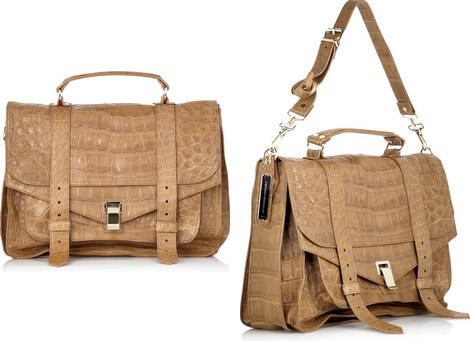
Finally! A $14,500 purse worth every penny


Suddenly, it dawned on me, after decades of minimalist fashion and frugal living. I've been saving myself for something really, really wonderful. After all, isn't the key to fabulous minimalism having a few "wow" pieces to contrast with the steady background of neutral basics? My morning Google break brought me to The Purse Blog, and I immediately got a Chris Matthews-esque tingle up my leg. Picture this bag with jeans and a black turtleneck. Or jeans and a white turtleneck. Of course, my frugality alarm went off at the price tag: $14,500! But then I realized I had probably saved that much on clothing in my lifetime, and the Proenza Schouler PS1 Crocodile Satchel was the reason. So I did it; it's on its way as I type these words: april fool.